Sunday, May 12, 2013
INTRODUCTION
This blog focuses on Chapter 30 of our European History books, which covers the 1960's all the way through 1991. It was during this time that Cold War tensions had relaxed significantly, and many people thought that global consistency and peace could be achieved. But in the 70's, the adolescent generation took to the counterculture movement and brought political and economic advancement to a halt, affecting every nation's government and causing many changes through reform and even war. We hope to compile, compress, and discuss the many aspects of this section of the book in a way that is not only insightful, but is inclusive to everyone, so that it may be a learning tool for anyone to use and understand. How did this group people with their new ideals manage to change the growth of nations around the world, and what sort of policies were introduced that still affect us today? All will be answered within...

#7- 3, 2, 1 Summary
3-
1) Going into this I only had a vague idea of what the Cold War was. I realized that nothing actually happened with this but did not connect the Vietnam war or the Korean conflict with soviet control. Now I know that it was a time of high tension between the Capitalists and Communists with nuclear weapons.
2) I learned what the USSR actually was and it's origins. I've always heard the "In soviet russia" jokes and not understand the context behind them (now I know it is makes fun of how backward of a country it was [and even is today]).
3) I learned that West Berlin was enveloped in soviet control, not just with one side of the communists. I had no idea that it was well into the depths of the East.
2-
1) The most interesting thing was how the whole the enemy of my enemy is my friend actually works (until that mutual enemy has been taken care of). Capitalists and Communists worked decently well together against the threat of fascism. Then after that they focused on each other. Just think of what would have happened if Capitalists and Fascists focused on Communists or vice versa.
2) The second most interesting thing that I learned is that the whole thing ended in 1991. 1991! That was only four years before I was born! When I was younger I thought that this has been a normal and stable time with everything important happening hundreds of years before myself, but the change is happening all around my era. I was illegitimately shocked.
1-
1) The question I still have is is the Cold War really over? China has some MAJOR things wrong with it, human rights issues, pollution, their communist government, but they seem to be as dependent on the US as we are them, which I'm sure is partially why we haven't addressed the major issues. When will those issues be addressed though? They too are a nuclear power, so will we just have to wait until their political system collapses and a new government takes place or what? It will be interesting to experience the history of it firsthand as I will be bold enough to assume it will happen within my lifetime.
By: Ethan Puller
1) Going into this I only had a vague idea of what the Cold War was. I realized that nothing actually happened with this but did not connect the Vietnam war or the Korean conflict with soviet control. Now I know that it was a time of high tension between the Capitalists and Communists with nuclear weapons.
2) I learned what the USSR actually was and it's origins. I've always heard the "In soviet russia" jokes and not understand the context behind them (now I know it is makes fun of how backward of a country it was [and even is today]).
3) I learned that West Berlin was enveloped in soviet control, not just with one side of the communists. I had no idea that it was well into the depths of the East.
2-
1) The most interesting thing was how the whole the enemy of my enemy is my friend actually works (until that mutual enemy has been taken care of). Capitalists and Communists worked decently well together against the threat of fascism. Then after that they focused on each other. Just think of what would have happened if Capitalists and Fascists focused on Communists or vice versa.
2) The second most interesting thing that I learned is that the whole thing ended in 1991. 1991! That was only four years before I was born! When I was younger I thought that this has been a normal and stable time with everything important happening hundreds of years before myself, but the change is happening all around my era. I was illegitimately shocked.
1-
1) The question I still have is is the Cold War really over? China has some MAJOR things wrong with it, human rights issues, pollution, their communist government, but they seem to be as dependent on the US as we are them, which I'm sure is partially why we haven't addressed the major issues. When will those issues be addressed though? They too are a nuclear power, so will we just have to wait until their political system collapses and a new government takes place or what? It will be interesting to experience the history of it firsthand as I will be bold enough to assume it will happen within my lifetime.
By: Ethan Puller
#3- US Events
US Events
The 1973 Oil Crisis- In 1973 after the Yom Kippur War, OPEC (The Organization of Petroleum Exporting Countries) did not export petroleum to countries that had supported Israel in the conflict leading to a large spike in the price of oil as the quantity had dropped. This led to President Nixon asking gas stations to only sell gas on the weekdays as well as asking to ration their gas as much as possible. The economy, heavily dependent on gasoline, experienced the sudden increase of price or oil shocks which was startled Americans by changing their lifestyle. They could no longer afford to waste gasoline.
The embargo was felt by several European nations as well. Great Britain experienced similar hardships as the United States though the Netherlands were by far the worst off, experiencing a complete embargo. They had such a hard time that prison sentences were given to those who used more than their given ration of electricity.

The First Moonwalk- In 1969 the American Neil Armstrong became the first man to ever walk on the moon. By doing this he fulfilled the challenge J.F.K. prompted to "land a man on the moon, and return him safely to the Earth." There had been a number of other missions to explore the surface of the moon and the environment of space in general. The actual landing of man made Armstrong and Buzz Aldrin national heroes and greatly influenced our culture. The first thing that was ever said on the moon was "That's one small step for man, one giant leap for mankind."
On the European side of things the other large contender in the space race was the USSR. They had been developing space exploration equipment at a similar and in someways faster rate than the US. For instance they had the first human in space. But in the end it was the US who took the real prize of being able to say they had the first humans on the moon.

By Ethan Puller
Connection Across Time: Mikhail Gorbachev
 Mikhail Gorbachev was the last premier of the USSR before it collapsed in 1991. Under his rule, with his democratized reforms, glasnost and perestroika, and his economic policy, the Soviet Union began to crumble slowly under his rule from 1985-1991. In 1991 Gorbachev was captured by Soviet Hardliners known as Apparatchiks, in an attempt by the Apparatchiks to stop the dissolution of the Soviet Union.
In 1996 he created the social democratic party of Russia. He resigned as party leader from that in 2004. Gorbachev has remained very active in world affairs, opposing the US bombing of Yugoslavia in 1999 and and the Iraqi war in 2003.
He has also credited Vladimir Putin for stabilizing Russia after the breakdown of the Soviet Union, but has lately taken to criticizing the "tag team" of Putin and Dmitry Medvedev, saying that they are sliding back on democracy and increasing corruption. He decried this retreat from democracy, calling the government an "imitation democracy" with "all power in the executive branch". He criticized Putin directly, saying "to go further on the path of tightening the screws, having laws that limit the rights and freedoms of people, attacking the news media and organizations of civil society, is a destructive path with no future."
Having read this, I doubt very much that Gorbachev ever wanted to revitalize Communism in Russia.
In 1996 he created the social democratic party of Russia. He resigned as party leader from that in 2004. Gorbachev has remained very active in world affairs, opposing the US bombing of Yugoslavia in 1999 and and the Iraqi war in 2003.
He has also credited Vladimir Putin for stabilizing Russia after the breakdown of the Soviet Union, but has lately taken to criticizing the "tag team" of Putin and Dmitry Medvedev, saying that they are sliding back on democracy and increasing corruption. He decried this retreat from democracy, calling the government an "imitation democracy" with "all power in the executive branch". He criticized Putin directly, saying "to go further on the path of tightening the screws, having laws that limit the rights and freedoms of people, attacking the news media and organizations of civil society, is a destructive path with no future."
Having read this, I doubt very much that Gorbachev ever wanted to revitalize Communism in Russia.
Connection: Afghanistan to now
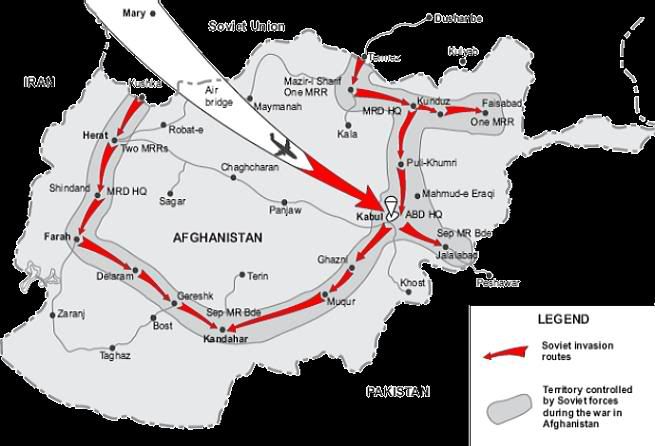 |
| Invasion path of the Soviet Union |
| Osama bin Laden |
Saturday, May 11, 2013
Art of the Period
http://www.curriculumlink.org/econ/materials/pc2.ht2.jpg
This political cartoon by Jeff Stahler is not one that necessarily criticizes Mikhail Gorbachev, but rather it pokes fun at his attempt to reform Communism with democratic policies. In 1985 Gorbachev established Perestroika, the first set of reform policies that could be considered "Capitalist" which were designed to restructure and renew the broken Soviet Economy. To do this he eased up on government restrictions, price control, and set up private corporations to benefit consumers. These were all ideals that drew the country far from what Communism had been defined as in past years, and many citizens fled the country when their theoretical chains were loose, hoping to start a new life in Western Europe.
http://img2-3.timeinc.net/ew/i/2011/10/18/Andy-Warhol-Liz_596.jpg
This is a very famous work of art, a painting of Elizabeth Taylor by Andy Warhol (I figured I'd choose something besides Marilyn). It does not seem to be very complex at first glance, but its significance rings true when it is compared to the culture of the sixties. In Chapter 30, a large portion of its pages is dedicated to the culture of this turbulent decade. This painting exemplifies the teachings of the sexual revolution that took place during these years. More young adults were involved in premarital sex and this highly stylized picture of the famous actress places emphasis on heavy makeup and colour, the base of sexual attraction at the time. It is a prime example of pop-art in the period, and the fact that it is picturing one who was so famous at the time only makes it more so.
This political cartoon by Jeff Stahler is not one that necessarily criticizes Mikhail Gorbachev, but rather it pokes fun at his attempt to reform Communism with democratic policies. In 1985 Gorbachev established Perestroika, the first set of reform policies that could be considered "Capitalist" which were designed to restructure and renew the broken Soviet Economy. To do this he eased up on government restrictions, price control, and set up private corporations to benefit consumers. These were all ideals that drew the country far from what Communism had been defined as in past years, and many citizens fled the country when their theoretical chains were loose, hoping to start a new life in Western Europe.

http://img2-3.timeinc.net/ew/i/2011/10/18/Andy-Warhol-Liz_596.jpg
This is a very famous work of art, a painting of Elizabeth Taylor by Andy Warhol (I figured I'd choose something besides Marilyn). It does not seem to be very complex at first glance, but its significance rings true when it is compared to the culture of the sixties. In Chapter 30, a large portion of its pages is dedicated to the culture of this turbulent decade. This painting exemplifies the teachings of the sexual revolution that took place during these years. More young adults were involved in premarital sex and this highly stylized picture of the famous actress places emphasis on heavy makeup and colour, the base of sexual attraction at the time. It is a prime example of pop-art in the period, and the fact that it is picturing one who was so famous at the time only makes it more so.
Tuesday, May 7, 2013
Picturing the Past: Woodstock

Monday, May 6, 2013
Important people during the Cold War
Willy Brandt
Willy Brandt became the first social democratic West German chancellor in 1969. The social democratic policy of detente, which aimed to reduce tensions between countries separated by the iron curtain, was spearheaded by Willy Brandt. In December 1970 he flew to Poland and laid a wreath at the tomb of the Polish unknown soldier, and another at the monument commemorating the armed uprising of Warsaw's Jewish ghetto against Nazi armies. He later said "I wanted to ask pardon in the name of our people for a million-fold crime which was committed in the misused name of the Germans."
Willy Brandt's policy of reconciliation with eastern Europe was termed Ostpolitik (eastern policy). Brandt wanted a comprehensive peace settlement for central Europe and the two German states, using his formula of "two German states within one German nation."
Mikhail Gorbachev
Became Soviet Premier in 1985: the last one to lead the Soviet Union. Gorbachev believed in Communism but knew that it was falling behind the Western capitalism and technological developments. He knew he had to save the Soviet system with fundamental reforms, but these fundamental reforms would set the USSR on the path of capitalism and democracy.
His first reforms were designed to restructure the economy from heavy industry to consumer goods. This was called Perestroika. Gorbachev permitted an easing of government price controls, and gave state enterprises more independence. His second reform platform was Glasnost, which was a campaign to "tell it like it is". This went against the longstanding Soviet tradition of heavy state censorship. This new openness in the state government led to writers selling millions of copies of their books denouncing Stalin, which became common. However, Glasnost went further than Gorbachev intended and led to something resembling free speech. His careful reforms snowballed out of control and a series of (mostly) peaceful revolutions swept across the Eastern Bloc, and in 1991 the Soviet Union was dissolved.
Margaret Thatcher
Margaret Thatcher brought to Britain a series of changes, one just by getting elected. Margaret Thatcher was the first woman elected to lead a major European state. She was radically different with her idealogies than any of her predecessors either: she was a neoliberal, which was termed as the 1980s conservative philosophy that argued for decreased government spending on social services, and privatization. Thatcher completely reversed Britain's previous "cradle-to-grave" welfare state that had been established. Thatcher's conservative party cut spending on health care, education, and public housing. Thatcher also curbed the power of labor unions, refusing to bend to their demands even though it had serious economic repercussions. She lowered taxes and privatized over fifty state-owned companies.
Willy Brandt

Willy Brandt became the first social democratic West German chancellor in 1969. The social democratic policy of detente, which aimed to reduce tensions between countries separated by the iron curtain, was spearheaded by Willy Brandt. In December 1970 he flew to Poland and laid a wreath at the tomb of the Polish unknown soldier, and another at the monument commemorating the armed uprising of Warsaw's Jewish ghetto against Nazi armies. He later said "I wanted to ask pardon in the name of our people for a million-fold crime which was committed in the misused name of the Germans."
Willy Brandt's policy of reconciliation with eastern Europe was termed Ostpolitik (eastern policy). Brandt wanted a comprehensive peace settlement for central Europe and the two German states, using his formula of "two German states within one German nation."
Mikhail Gorbachev

Became Soviet Premier in 1985: the last one to lead the Soviet Union. Gorbachev believed in Communism but knew that it was falling behind the Western capitalism and technological developments. He knew he had to save the Soviet system with fundamental reforms, but these fundamental reforms would set the USSR on the path of capitalism and democracy.
His first reforms were designed to restructure the economy from heavy industry to consumer goods. This was called Perestroika. Gorbachev permitted an easing of government price controls, and gave state enterprises more independence. His second reform platform was Glasnost, which was a campaign to "tell it like it is". This went against the longstanding Soviet tradition of heavy state censorship. This new openness in the state government led to writers selling millions of copies of their books denouncing Stalin, which became common. However, Glasnost went further than Gorbachev intended and led to something resembling free speech. His careful reforms snowballed out of control and a series of (mostly) peaceful revolutions swept across the Eastern Bloc, and in 1991 the Soviet Union was dissolved.
Margaret Thatcher
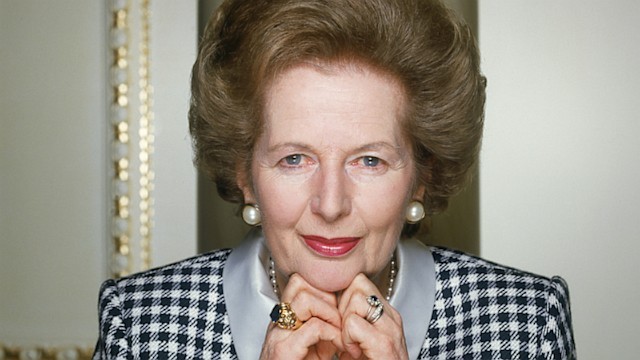
Margaret Thatcher brought to Britain a series of changes, one just by getting elected. Margaret Thatcher was the first woman elected to lead a major European state. She was radically different with her idealogies than any of her predecessors either: she was a neoliberal, which was termed as the 1980s conservative philosophy that argued for decreased government spending on social services, and privatization. Thatcher completely reversed Britain's previous "cradle-to-grave" welfare state that had been established. Thatcher's conservative party cut spending on health care, education, and public housing. Thatcher also curbed the power of labor unions, refusing to bend to their demands even though it had serious economic repercussions. She lowered taxes and privatized over fifty state-owned companies.
Thursday, March 7, 2013
Publishing Problems
I assure you that there was an abundance of pictures and visual representations in these posts. I'm afraid that they were lost over the PC-Mac transfer or something related to that. If you need I can post provide proof that I had visual aids by bringing my computer into class.
Wednesday, March 6, 2013
Imperialism Part 9: Reflection Time
3 Things I Learned:
1) I had no idea how incredibly heated debates about the nature of U.S. Imperialism could be. I also had no idea it was such a big argument. I searched through many sites to find the information I needed on the subject and some individuals were very defensive about their opinions on the subject.
2) I learned that the Russians played a large part in the ignition of the Boxer Rebellions and previously I truly didn't have any idea that they were involved at all in that conflict.
3) I learned what the Suez Canal was. No, seriously. I knew there was a canal between the Indian Ocean and the Mediterranean but I never actually knew its name (or maybe my mind chose to forget). I'm gladthat I know this now to be saved the embarrassment in the future.
2 Things That Interested You:
1) I really enjoyed researching about the Sepoy Rebellion, something about it is incredibly compelling to me and I'm glad that I delved deeper into the subject than what we just learned in class.
2) For the most part, I really liked looking for new political cartoon, even if it was virtually impossible to find who had drawn them, their titles, when they were published etc...
1 Question You Still Have:
1) Why wasn't the Suez Canal built sooner? I can understand if the explanation is "lack of technilogical capability" but if it took people that long to get down to making trading in the East easier, they could possibly be crazy.
1) I had no idea how incredibly heated debates about the nature of U.S. Imperialism could be. I also had no idea it was such a big argument. I searched through many sites to find the information I needed on the subject and some individuals were very defensive about their opinions on the subject.
2) I learned that the Russians played a large part in the ignition of the Boxer Rebellions and previously I truly didn't have any idea that they were involved at all in that conflict.
3) I learned what the Suez Canal was. No, seriously. I knew there was a canal between the Indian Ocean and the Mediterranean but I never actually knew its name (or maybe my mind chose to forget). I'm gladthat I know this now to be saved the embarrassment in the future.
2 Things That Interested You:
1) I really enjoyed researching about the Sepoy Rebellion, something about it is incredibly compelling to me and I'm glad that I delved deeper into the subject than what we just learned in class.
2) For the most part, I really liked looking for new political cartoon, even if it was virtually impossible to find who had drawn them, their titles, when they were published etc...
1 Question You Still Have:
1) Why wasn't the Suez Canal built sooner? I can understand if the explanation is "lack of technilogical capability" but if it took people that long to get down to making trading in the East easier, they could possibly be crazy.
Saturday, March 2, 2013
Imperialism Part 8: Spotlight on the Suez Canal
THE SUEZ CANAL

Friday, March 1, 2013
Imperialism Part 7: The Libyan Revolution
The Libyan revolution was a 2011 armed conflict in the Libya, fought between forces loyal to Colonel Muammar Gaddafi and those seeking to oust his government. The war was preceded by protests in Benghazi beginning on Tuesday, 15 February 2011, which led to clashes with security forces that fired on the crowd. The protests escalated into a rebellion that spread across the country. When the U.N. initialized a resolution which froze all of Gaddafi's assets, he agreed to a ceasefire but failed to uphold it. In August, rebel forces launched an offensive on the coast of Libya, taking back territory lost months before and capturing the capital city of Tripoli.Muammar Gaddafi was still at large until 20 October 2011, when he was captured and killed attempting to escape the city of Sirte. Though the upriaing against Gaddafi was large, loyalists are still at large and cause damage to the cause of the people daily. It's still a postive ending for the people of Libya though.

Monday, February 25, 2013
Imperialism Part 6: The Sepoy Rebellion

One of the most well-known uprisings during the British colonization of India was a mutiny of the native troops known as sepoys. When it began on Sunday, May 10, 1857 the Sepoy rebellion was a complete surprise to the British, many of whom were blind to the unrest that had been created. After Britain had gained two-thirds of India's land and imperialism had begun to affect every part of Indian life there was an incredible amount of tension that only needed a small spark to set off a huge revolt. The spark that came to begin this period of revolts was the introduction of the new, more accurate breech-loading Enfield rifle. The loading of these rifles entailed the biting of a greased cartridge, which the sepoys feared was made with either cow or pig fat. The Hindus in the army held the animals sacred, while the Muslims found them to be unclean.The first event was the bloody uprising at the garrison in Meerut, in which the mutineers murdered every European they found. Throughout May and June the idea of mutiny spread. On July 17 it was discovered that 200 European men, women, and children had been murdered a month earlier in the mutiny and siege at Cawnpore. Suspected mutineers were tied to cannons and executed. In six months, the mutiny had been broken, and, within the next year, British power was restored.

Imperialism Part 5


The Boxer Rebellion and the Russian Invasion of Manchuria are very closely related in history, being part of the same war struggles, but a comparison between the two is a great connection across continents. When looking at these events, it makes it possible to understand the European disposition and it differences with the Asians'. In fact, through the Russian forces, you can see how determined the rest of the world was to have their spheres of influence in China seen through by the death of the Rebellion
Thursday, February 21, 2013
Imperialism Part 4
U.S. IMPERIALISM
I myself do not think that the U.S. has been Imperialist but there is evidence for both sides.
Pros for Imperialism:
1)The Examples of the Louisianna Purchase and the government's urgent Manifest Destiny push both provide the basis for belief in an Imperialist America. In these situations, most would say that the country was intended to gain land from the Native Americans for selfish purposes.
2) The induction of Hawaii into the American states is a common example of Imperialism. The country took over the island, regardless of the fact that it was a long distance from its coast, and has kept it ever since.
3)The U.S.' takeover of Central American islands after the Spanish-American War is considered to e extremely Imperialistic by nature. We practically invaded their homes and told them that we were in charge.
Cons for Imperialism:
1)The U.S., while being present in many of these nations, has steered clear of takeover in the Middle East, leaving Iran, Iraq, Afghanistan etc. to continue their governmental control without anything more than their military presence.
2)If the U.S. desired to take more land and create greater spheres of influence, it would have been done already. We have the intelligence, drive, and power to intiate a takeover of any country in the world, but we have not, because we are not truly Imperialistic.
3)The Constitution sets forth a principle that calls for the "consent of the governed." To imperialize, and thus annex other colonies would violate this important aspect of our democracy.
Thursday, February 14, 2013
Imperialism Part 3: Current Political Cartoons

Wednesday, February 13, 2013
Imperialism Part 2: The "Whimsical" Side of Politics
Political cartoons can be sources of humour, entertainment, scrutiny, public ire, and political insightfulness. Oftentimes, in this medium, they are all one and the same. Here are some political cartoons from the time period that reflect on and poke fun at Imperialism.
1)
 This cartoon, published in 1899, portrays Uncle Sam holding his new possessions: Puerto Rico, the Philippines, Hawaii, Cuba, and Ladrones (Guam). The author indicates that the U.S. has been Imperialistic in it "conquests" through the impoverished (and Phillippines' and Landrones' unhappy countenances) stature he portrays the countries in. Sam, while being dressed somewhat embarrassingly, is mostly clothed and the men/boys and barely wearing anything at all, showing that they are quite opposed to the takeover or influence of America. Personally, I think this is a brilliant cartoon, even if I don't necessarily agree with its message. It very accurately depicts the way in which many perceived the bold actions of the American government at the time and the visual representation of Uncle Sam holding up the different countries as if they are savage children is very fitting in its depiction.
2)
 This Harper's Weekly cartoon by W. A. Rogers encourages an aggressive American military reaction to the Boxer Rebellion in China.The shock of Japan's defeat of China in the Sino-Japanese War of 1894-1895 spurred the Chinese government to initiate reforms and open itself to Western influence. However, the Empress Dowager, Tz'u-hsi, and many other Chinese favored traditional ways, so the reforms were only implemented in one province. The Western powers took advance of this period of turmoil to carve up China into their own spheres of influence. During the Boxer Revolt of Peking, McKinley sent 2500 troops to repress the situation there and was labelled "Imperialistic" because of it. This hadn't happened at the time that the cartoon was illustrated however. The author inteded to wind people up to the crises in China by portraying the Boxers as weak and sporadically insane, next to the gentleman-ly stature of Uncle Sam preparing to sail his forces to put down the uprising. I think that this work is very important in the span of history that it occupies. I'm not enitrely sure how influential the cartoon was itself, but it is very striking and straighforward in its message. I'm sure many people supported military mobilization because of this.
1)

2)

Sunday, February 10, 2013
Imperialism Part 1
This blog, under the direction of Maz, will serve to explain/discuss/evaluate the many sides of Imperialism and how it is involved in Chapter 25 in A History of Western Society, as well as the world today. The chapter itself details the time between 1815 and 1914 when industrialization had led to innovation, invention, and imperialism. As the empires of the European markets expanded and the populous overflowed out of the continent, no country was left untouched by the influence of Westernization. Yet some, meaning those under practical enslavement, had the age of Imperialism off a little worse than others.
An essential question for thought: Though this may be over a century in the past, is Imperialism still a concept that is used and expressed today.
Yes, in many ways Imperialism is still active and arguably ubiquitous. Many individuals and groups even consider America's reputation as a country of freedom to be based on the political, economic, and social domination that is Imperialism. Though this is a subject of strong debate, there is no doubt that even within the past thirty five years there have been instances of governmental takeover by outside forces, spheres of influence.
An essential question for thought: Though this may be over a century in the past, is Imperialism still a concept that is used and expressed today.
Yes, in many ways Imperialism is still active and arguably ubiquitous. Many individuals and groups even consider America's reputation as a country of freedom to be based on the political, economic, and social domination that is Imperialism. Though this is a subject of strong debate, there is no doubt that even within the past thirty five years there have been instances of governmental takeover by outside forces, spheres of influence.
Subscribe to:
Posts (Atom)