Important people during the Cold War
Willy Brandt
Willy Brandt became the first social democratic West German chancellor in 1969. The social democratic policy of detente, which aimed to reduce tensions between countries separated by the iron curtain, was spearheaded by Willy Brandt. In December 1970 he flew to Poland and laid a wreath at the tomb of the Polish unknown soldier, and another at the monument commemorating the armed uprising of Warsaw's Jewish ghetto against Nazi armies. He later said "I wanted to ask pardon in the name of our people for a million-fold crime which was committed in the misused name of the Germans."
Willy Brandt's policy of reconciliation with eastern Europe was termed Ostpolitik (eastern policy). Brandt wanted a comprehensive peace settlement for central Europe and the two German states, using his formula of "two German states within one German nation."
Mikhail Gorbachev
Became Soviet Premier in 1985: the last one to lead the Soviet Union. Gorbachev believed in Communism but knew that it was falling behind the Western capitalism and technological developments. He knew he had to save the Soviet system with fundamental reforms, but these fundamental reforms would set the USSR on the path of capitalism and democracy.
His first reforms were designed to restructure the economy from heavy industry to consumer goods. This was called Perestroika. Gorbachev permitted an easing of government price controls, and gave state enterprises more independence. His second reform platform was Glasnost, which was a campaign to "tell it like it is". This went against the longstanding Soviet tradition of heavy state censorship. This new openness in the state government led to writers selling millions of copies of their books denouncing Stalin, which became common. However, Glasnost went further than Gorbachev intended and led to something resembling free speech. His careful reforms snowballed out of control and a series of (mostly) peaceful revolutions swept across the Eastern Bloc, and in 1991 the Soviet Union was dissolved.
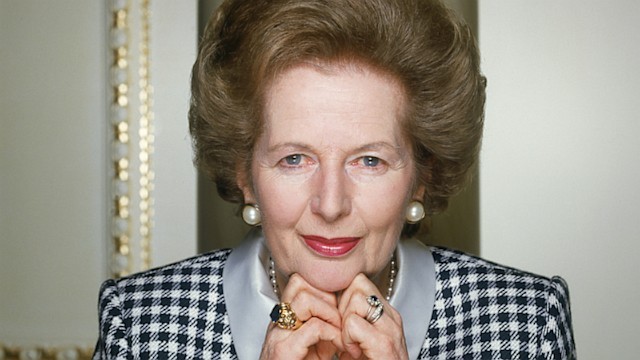
Margaret Thatcher
Margaret Thatcher brought to Britain a series of changes, one just by getting elected. Margaret Thatcher was the first woman elected to lead a major European state. She was radically different with her idealogies than any of her predecessors either: she was a neoliberal, which was termed as the 1980s conservative philosophy that argued for decreased government spending on social services, and privatization. Thatcher completely reversed Britain's previous "cradle-to-grave" welfare state that had been established. Thatcher's conservative party cut spending on health care, education, and public housing. Thatcher also curbed the power of labor unions, refusing to bend to their demands even though it had serious economic repercussions. She lowered taxes and privatized over fifty state-owned companies.


No comments:
Post a Comment